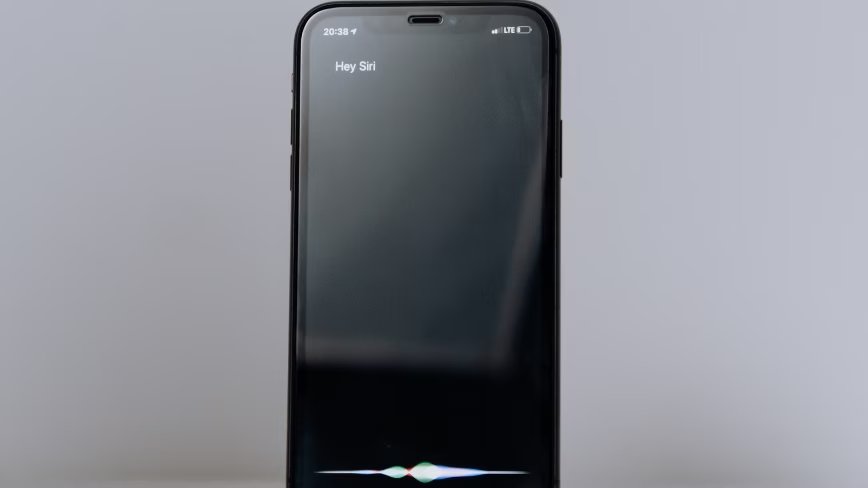
A New Era for Siri: Chat-Based and Privacy-Focused
Apple is poised to unveil a major overhaul of its virtual assistant, Siri, with the release of iOS 27, transforming it into a full-fledged chatbot application that will include an auto-delete function for chat histories. This significant revamp is expected to debut at Apple's Worldwide Developers Conference (WWDC) in June, where privacy is anticipated to be a central theme. The new Siri app will function as a repository for past conversations, akin to popular AI chatbots like OpenAI's ChatGPT and Anthropic's Claude.
Users will be able to interact with the redesigned Siri through a dedicated app, offering both voice and text input, file uploads, and web-sourced answers complete with images and bullet points. The interface is described as resembling iMessage, allowing for threaded conversations, and users will have the option to favorite, search, and save individual chats. This marks a fundamental shift from the current Siri experience, where interactions are largely ephemeral.
Auto-Deletion as a Core Privacy Differentiator
The standout feature of the revamped Siri is its auto-delete functionality for chat histories, a privacy control borrowed from the Messages app. Users will have the ability to configure the app to retain conversations for specific durations: 30 days, one year, or indefinitely. This approach positions Apple's AI privacy strategy as fundamentally different from competitors who often offer temporary or incognito chat modes as optional settings that users must manually enable.
Apple's stance is that privacy protections should be an inherent part of the system, rather than an opt-in feature. By defaulting to structured retention limits, Apple aims to convey that its AI assistant is designed to "forget," contrasting with systems built to remember everything for continuous improvement. This strategy could make Siri more appealing for sensitive, everyday questions where users prefer their data not to be preserved indefinitely.
The Strategic Context: Catching Up in the AI Race
Apple's entry into the generative AI chatbot space comes after a period where it has lagged behind competitors in terms of speed and spectacle. The company has reportedly replaced much of its own AI infrastructure with Google's Gemini, paying approximately $1 billion annually for a custom 1.2-trillion-parameter model to power the next-generation Siri. Despite this partnership, Apple intends to run the Gemini-based Siri on its own Private Cloud Compute servers, extending the iPhone's security model into the cloud.
The delay in Siri's overhaul, which was initially expected in 2024, now allows Apple to frame its cautious approach as a virtue, emphasizing privacy over a rushed deployment. However, reports suggest that even after a two-year delay, the new Siri may still launch with a "beta" label within iOS 27. This indicates that Apple may still be refining the experience, and users will reportedly have the option to leave the Siri beta program entirely.
User Control and Interface Options
Beyond the auto-delete feature, the revamped Siri will offer users additional controls over their experience. Users can choose whether the app opens to a grid of prior conversations or directly into a new chat each time. The new Siri can be activated through the standard Siri activation methods, such as the side button or wake word, or via a new "Search or Ask" mode triggered by swiping down from the top center of the screen.
While the auto-delete feature offers a clear privacy benefit, there is a potential trade-off: a Siri that forgets preferences after 30 days may not learn from user history in the same way that continuously learning chatbots like ChatGPT or Claude do. Apple's challenge will be to clearly communicate the practical implications of these retention settings and ensure that the meaning of "deletion" is transparent, especially if the assistant maintains separate learned preferences or on-device context summaries.
